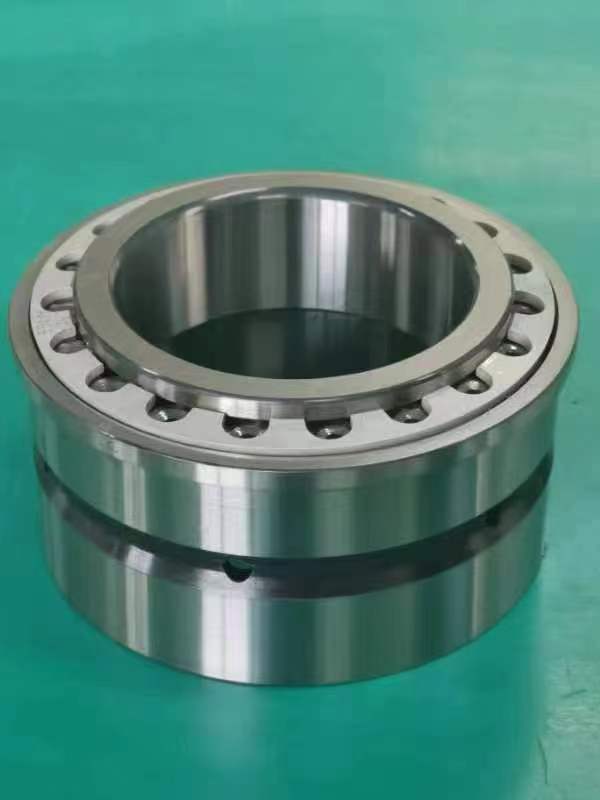
Selecting the right precision angular contact ball bearings is one of the most critical decisions in machine tool spindle design. The bearing directly determines the spindle's accuracy, speed capability, rigidity, and service life. This guide examines the key factors — accuracy grades, ceramic hybrid technology, preload, cage materials, and lubrication — to help buyers make informed decisions.
Accuracy Grades: P4 vs P2 Explained
Precision angular contact ball bearings are classified by tolerance grades defined in ISO 492 (equivalent to DIN 620 and ABEC standards). For machine tool spindle applications, P4 (ABEC-7) and P2 (ABEC-9) are the two most commonly specified grades.
P4 (ABEC-7) bearings offer dimensional accuracy within 4 microns for bore and OD tolerances, with runout typically below 2 microns. This grade is suitable for most general-purpose CNC machining centers, milling spindles, and grinding spindles where cost-performance balance is important. P4 bearings deliver excellent rigidity and are readily available across a wide size range from 10mm to 200mm bore diameters.
P2 (ABEC-9) represents the highest commercially available precision grade for angular contact bearings. Tolerances are tightened to approximately half of P4 values — dimensional accuracy within 2.5 microns and runout below 1.5 microns. P2 bearings are specified for ultra-precision applications including jig boring machines, diamond turning lathes, coordinate measuring machines, and high-speed grinding spindles operating above 30,000 RPM. The tighter tolerances reduce vibration, improve surface finish quality, and extend tool life in demanding applications.
| Parameter | P4 (ABEC-7) | P2 (ABEC-9) |
|---|---|---|
| Bore Tolerance | ≤ 4 µm | ≤ 2.5 µm |
| Radial Runout | ≤ 2 µm | ≤ 1.5 µm |
| Typical Speed Rating | Up to 24,000 RPM | Up to 60,000 RPM |
| Best For | General CNC, milling, grinding | Ultra-precision, diamond turning, CMM |
Ceramic Hybrid Bearings: The Performance Advantage
Ceramic hybrid angular contact ball bearings use silicon nitride (Si3N4) balls paired with steel rings. This combination delivers several decisive advantages over all-steel bearings for high-speed spindle applications.
Silicon nitride balls are approximately 60% lighter than equivalent steel balls, which dramatically reduces centrifugal force and skidding at high rotational speeds. The lower density enables 30-50% higher speed ratings while generating less heat. Si3N4 also exhibits a lower coefficient of thermal expansion, providing more stable preload across temperature changes. Additionally, the ceramic material is electrically insulating, preventing damaging current passage through the bearing — a critical feature for motorized spindles where stray shaft currents can cause premature bearing failure through electrical erosion.
The hardness of silicon nitride (typically 1,600 HV compared to 700 HV for bearing steel) provides superior wear resistance and longer service life, especially under marginal lubrication conditions or when contamination is present.
Preload Strategies for Spindle Bearings
Angular contact bearings in machine tool spindles must operate under preload to eliminate internal clearance and achieve the required stiffness. Three preload methods are common:
- Spring preload (constant pressure) — Uses coil or wave springs to apply a consistent axial force regardless of thermal expansion. Ideal for high-speed spindles where thermal growth must be accommodated without overloading. Spring preload is simpler to implement and more forgiving of temperature variations.
- Fixed (rigid) preload — Achieved by precision-ground spacers that set a specific axial offset between inner and outer rings. Provides maximum stiffness but requires careful calculation of thermal expansion. Used in applications demanding the highest rigidity, such as heavy milling spindles.
- Adjustable/variable preload — Hydraulic or piezoelectric systems that dynamically adjust preload based on operating conditions. An emerging technology for spindles that alternate between high-speed finishing and heavy roughing cuts, though complex and costly.
Cage Materials and Their Impact
The bearing cage (retainer) guides and separates the rolling elements. Material choice significantly affects bearing speed capability and reliability:
- Phenolic resin (fabric-reinforced) — Lightweight, porous, and self-lubricating. Excellent for high-speed spindles. Absorbs oil and releases it gradually. The most common choice for precision spindle bearings operating at high DN values (bore diameter mm x RPM).
- PEEK (polyetheretherketone) — High-performance thermoplastic with superior chemical resistance and temperature capability (up to 250 degrees C). Increasingly specified for demanding applications with aggressive lubricants or elevated temperatures.
- Brass — Machined brass cages offer exceptional strength and durability, suitable for heavy-load, lower-speed applications. The higher mass limits use at very high speeds, but superior toughness withstands shock loads and vibration better than polymer cages.
Lubrication: Grease vs Oil-Air vs Oil-Mist
Proper lubrication is essential for bearing life and performance. The choice depends on the spindle's speed (DN value) and duty cycle:
- Grease lubrication — Suitable for DN values up to approximately 1,000,000. Modern spindle greases with synthetic base oils and polyurea thickeners provide excellent performance with minimal maintenance. Typically fills 20-30% of the bearing's free space. Most practical for general-purpose machining spindles.
- Oil-air (oil-spot) lubrication — For DN values between 1,000,000 and 2,500,000. A precise, metered quantity of oil is delivered by compressed air. Provides maximum cooling and allows the highest speeds while minimizing oil quantity to reduce churning losses. Standard for high-speed machining centers and grinding spindles above 15,000 RPM.
- Oil-mist (oil-fog) lubrication — Fine oil particles carried by air flow continuously lubricate the bearing. Effective for very high-speed applications but being phased out in many regions due to environmental and health concerns around oil aerosol emissions.
Luoyang Songju Precision Bearing Capabilities
Luoyang Songju supplies precision angular contact ball bearings in P4 and P2 accuracy grades, available in both all-steel and ceramic hybrid configurations. Our bearing range covers bore diameters from 10mm to 500mm, with standard 15-degree and 25-degree contact angles. We offer phenolic, PEEK, and brass cage options, and can supply matched sets with preload ground to your specifications. All bearings undergo 100% inspection with certified measurement reports. Contact our engineering team to discuss your specific spindle bearing requirements.
The optimal bearing configuration for any spindle application depends on the interplay of accuracy requirements, speed, load conditions, and cost constraints. For most CNC machining center applications, P4 ceramic hybrid bearings with phenolic cages and grease lubrication represent an excellent balance of performance and value. For ultra-high-speed applications above 24,000 RPM, upgrading to P2 grade, oil-air lubrication, and optimized preload becomes necessary to achieve the required precision and reliability.