
The global precision bearings market has reached an estimated $89.4 billion in 2026, growing at a compound annual growth rate (CAGR) of approximately 6.3%. Machine tool spindle bearings represent the largest and most technically demanding segment, driven by the global expansion of CNC machining capacity and the relentless push toward higher speeds, tighter tolerances, and longer service life.
Market Structure and Key Segments
The precision bearing market spans multiple product categories. Angular contact ball bearings dominate the machine tool spindle segment, favored for their ability to support combined radial and axial loads with high stiffness. Cylindrical roller bearings serve as support bearings in spindle arrangements, handling heavy radial loads. Tapered roller bearings find applications in turning and milling spindles requiring maximum rigidity. Interspersed across these categories, the growing adoption of ceramic hybrid bearings is reshaping performance expectations, particularly in the high-speed segment above 12,000 RPM.
Demand Drivers
Several macro trends are propelling precision bearing demand. The global expansion of CNC machine tool production — China alone produces approximately 300,000 CNC units annually — creates sustained demand for spindle-grade bearings. The electrification of automotive manufacturing requires new production lines with specialized machining centers, each incorporating multiple precision spindles and bearing sets. The aerospace industry consumes high volumes of premium P2-grade bearings for five-axis machining of structural components and engine parts. And the semiconductor equipment sector demands ultra-precision bearings with nanometer-level runout for wafer handling and lithography systems.
An important structural trend is the aftermarket bearing demand from spindle repair and rebuild operations. With hundreds of thousands of CNC spindles in operation globally, the replacement bearing market constitutes a substantial and recurring revenue stream for bearing manufacturers. Typical spindle bearing replacement intervals range from 8,000 to 20,000 operating hours depending on speed, loading, and lubrication conditions.
Regional Dynamics
Asia-Pacific commands the largest share of precision bearing consumption at approximately 50% of global demand, driven by China's massive machine tool base and the dense manufacturing ecosystems of Japan, South Korea, and Taiwan. Europe accounts for roughly 25%, led by Germany's premium machine tool industry and the region's strong automotive and aerospace sectors. North America holds about 18%, supported by aerospace manufacturing, defense programs, and reshoring of advanced production capacity.
Technology Trends Through 2030
Looking ahead, several technology shifts will shape the precision bearing market. Ceramic hybrid bearings are projected to grow from approximately 15% of spindle bearing sales to over 30% by 2030 as costs decline and speed requirements increase. Integrated sensor bearings — with embedded temperature, vibration, and speed sensing — will enable predictive maintenance and align with Industry 4.0 adoption. Advanced surface coatings such as diamond-like carbon (DLC) and tungsten carbide-based treatments will extend bearing life under marginal lubrication conditions. And additive manufacturing of bearing cages will enable optimized geometries for reduced weight and improved lubricant flow in high-speed applications.
Luoyang Songju: Your Precision Bearing Partner
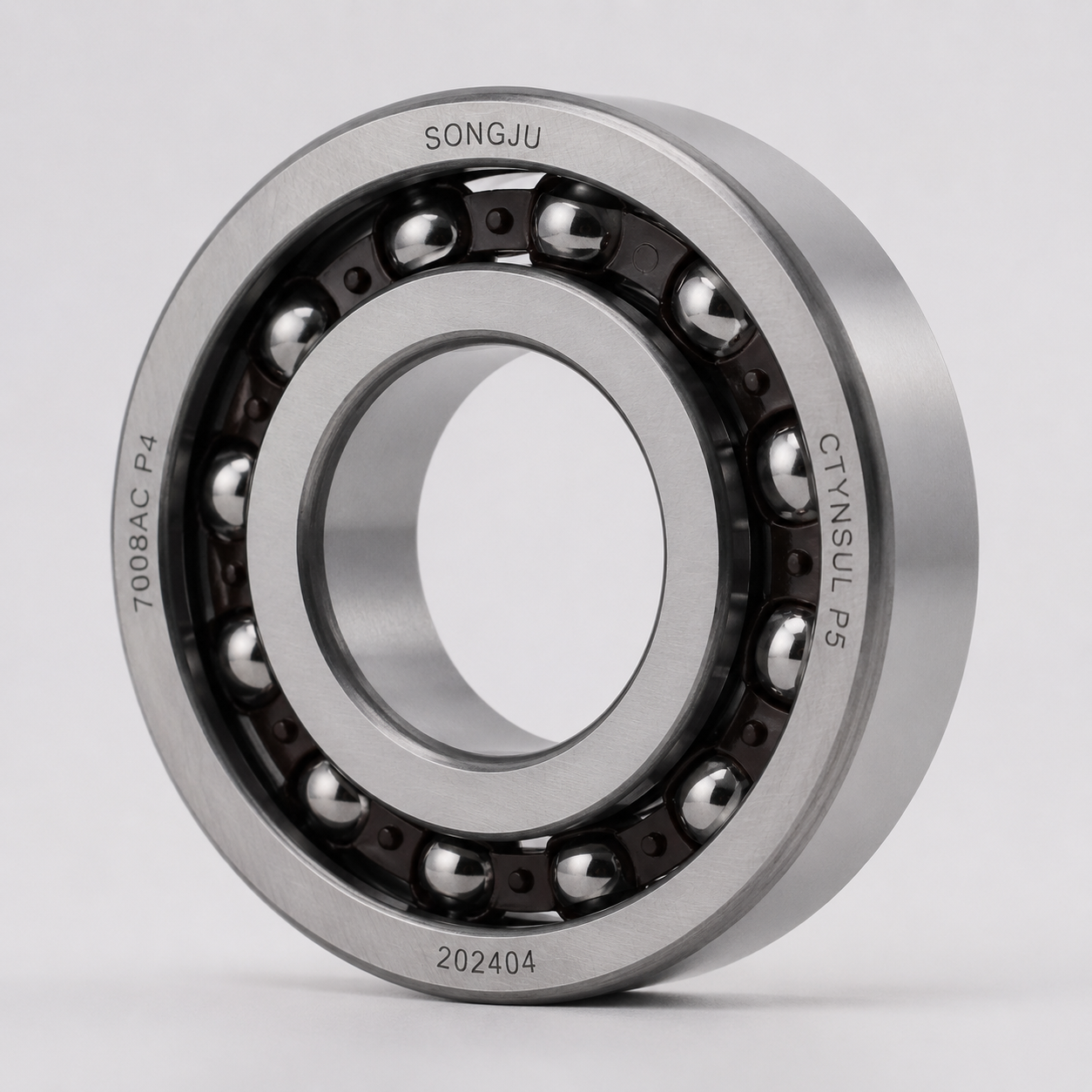
Luoyang Songju supplies precision angular contact ball bearings and cylindrical roller bearings in P4 (ABEC-7) and P2 (ABEC-9) accuracy grades, available in both all-steel and ceramic hybrid configurations. Our bearing range covers bore diameters from 10mm to 500mm, with standard and custom contact angles. We provide matched bearing sets with preload ground to specification, complete with certified dimensional and runout inspection reports. Contact our team for competitive pricing and technical consultation on your spindle bearing requirements.
The $89 billion precision bearings market is poised for sustained growth through the end of the decade, with machine tool spindles remaining the most demanding and highest-value application. Manufacturers who can deliver consistent quality, ceramic hybrid technology, and sensor-ready designs will capture disproportionate share in this expanding market.