
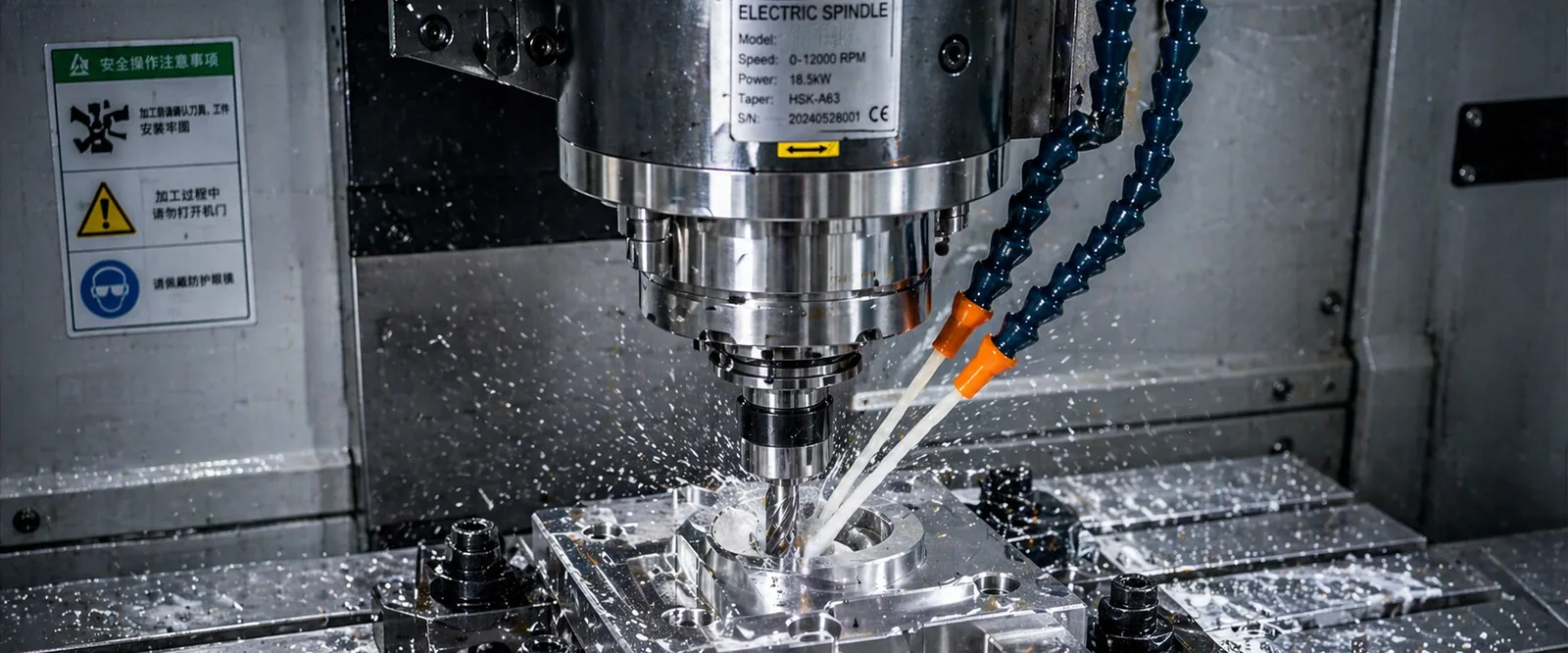
Choosing the correct electric spindle is fundamental to achieving the machining performance, accuracy, and productivity your operation demands. A spindle is not simply a motor ?it is a precision-engineered system where power, speed, torque, bearing arrangement, cooling, and tool interface must all work in concert. This guide walks through the key technical factors to evaluate when selecting an electric spindle for CNC machining applications.
1. Power Rating (kW) ?Match the Cut, Not the Nameplate
Spindle power directly determines the material removal rate (MRR) achievable. For aluminum machining, a general rule is 0.2-0.3 kW per cm3/min of material removal. Steel and titanium demand 0.5-0.8 kW per cm3/min. However, continuous power rating (S1 duty) matters more than peak power (S6). Many spindles are marketed at S6-40% ratings that cannot be sustained in production. Always request the S1 continuous power curve and ensure it covers your typical cutting parameters. For most VMC applications, 7.5-15 kW continuous is sufficient; heavy milling of steel and cast iron may require 18-30 kW.
2. Speed Range and Torque Characteristics
The spindle's speed range must cover the sweet spot for your tooling and materials. Small-diameter tools (below 6mm) in aluminum require 20,000-40,000 RPM to achieve efficient cutting speeds. Larger face mills in steel operate optimally at 2,000-6,000 RPM. The torque curve reveals the spindle's true capability: constant torque region (below base speed) determines heavy cutting ability, while constant power region (above base speed) governs high-speed finishing. A spindle with a wide constant-power range ?for example, from 3,000 to 18,000 RPM ?provides flexibility across diverse machining tasks.
| Application | Recommended Speed Range | Torque Priority |
|---|---|---|
| Aluminum High-Speed Milling | 20,000 - 40,000 RPM | Low-medium |
| Steel Heavy Milling | 2,000 - 10,000 RPM | High |
| General VMC | 8,000 - 15,000 RPM | Medium-high |
| Mold & Die Finishing | 15,000 - 30,000 RPM | Low-medium |
| Internal Grinding | 30,000 - 120,000 RPM | Low |
3. Bearing Type ?The Heart of Spindle Precision
The bearing arrangement defines the spindle's accuracy, rigidity, and speed limit. Angular contact ball bearings in P4 or P2 grade are standard. For spindles operating above 15,000 RPM, ceramic hybrid bearings with silicon nitride balls are strongly recommended ?they reduce centrifugal load, lower operating temperature, and extend grease life. The bearing arrangement (back-to-back, face-to-face, or tandem) and preload method (spring vs. fixed) must be matched to the application's stiffness and thermal requirements.
4. Cooling Method ?Protecting Precision Under Load
Thermal growth is the enemy of precision. Even a 10 degrees C temperature rise can cause several microns of axial growth, directly affecting dimensional accuracy. Three cooling approaches are common:
- Water jacket cooling ?A water-glycol circuit through the spindle housing. The most effective method for spindles above 7.5 kW or operating continuously. Maintains temperature within 2-3 degrees C of setpoint.
- Oil-air cooling ?Forced oil-air circulation around motor windings and bearings. Preferred for ultra-high-speed spindles where water jackets alone are insufficient.
- Fan cooling ?Simple but limited effectiveness. Only suitable for low-duty-cycle, low-power spindles where temperature control is not critical.
5. Tool Interface ?Standardization Meets Performance
The tool interface must match your existing toolholders. Common options include BT40, BT30, HSK-A63, HSK-E40, and ISO 30 tapers. HSK interfaces provide superior radial and axial repeatability at high speeds due to dual-contact face-and-taper design, making them the preferred choice for high-speed machining above 20,000 RPM. For lower-speed, high-torque applications, BT40 remains the industry standard with broad tooling availability and lower cost.
6. Motor Technology ?Synchronous vs. Asynchronous
Modern CNC spindles use either synchronous permanent magnet motors or asynchronous induction motors. Synchronous motors deliver higher power density, better efficiency, and superior low-speed torque ?critical for rigid tapping and heavy low-speed cutting. They are the dominant choice in new machining center designs. Induction motors remain viable for very high-speed grinding spindles where their simpler rotor construction enables higher RPM limits.
Luoyang Songju Spindle Selection Support
Luoyang Songju offers electric spindles from 0.5 kW to 100 kW, speeds from 3,000 to 120,000 RPM, with BT/HSK/ISO tool interfaces. Our engineering team reviews your application requirements ?material, tooling, duty cycle, accuracy targets ?and recommends the optimal spindle configuration. We support all common cooling and lubrication methods and provide S1/S6 power curves with every quotation.
Selecting the right electric spindle requires balancing multiple interacting parameters. Prioritize continuous power and torque over peak numbers, ensure the bearing and cooling systems match your duty cycle, and align the tool interface with your existing tooling inventory. Working with an experienced spindle manufacturer who can provide detailed performance data and application engineering support will ensure your selection delivers reliable, precise machining for years to come.