Ball Screws
HJG-S | Ground C3/C5 and rolled C7 | Ø8–100 mm | DIN 69051
HJG-S converts rotation to linear travel at 90–95% efficiency. Single and double nuts, internal deflector or external tube, large-lead and micro constructions. Diameters 8–100 mm, DIN 69051.
What Is a Ball Screw?
A ball screw is a mechanical linear actuator that converts rotary motion into linear motion with minimal friction. It consists of a threaded shaft (screw), a nut containing recirculating ball bearings, and precision-ground raceways. As the screw rotates, balls roll along the helical groove, transferring motion through the nut while providing extremely low rolling resistance.
The catalog puts HJG-S mechanical efficiency at 90–95%, about three times that of an ACME lead screw. Precise grinding and assembly plus strict inspection give high repeated positioning and driving accuracy, and axial play can be reduced to zero by preloading, so rigidity is greatly improved — especially by offset-lead preloading on the entire nut.
Low Friction
Rolling contact reduces energy loss
High Accuracy
Micron-level positioning repeatability
Long Service Life
Hardened raceways resist wear
High Speed Capability
Smooth operation across wide RPM range
Ball Screw Series Overview
HJG-S constructions: exposed tube, enclosed tube, internal curved deflector (single or double nut), external-return double nut, and large-lead / micro screws.
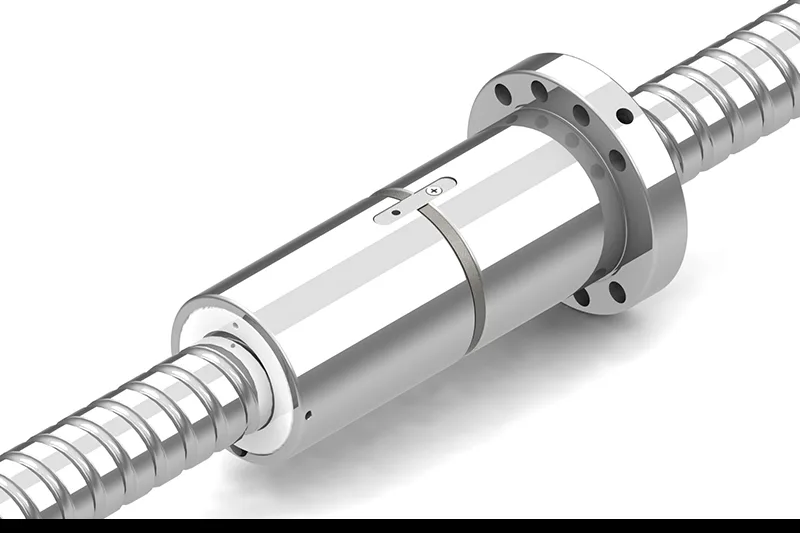
HJG-S Double Nut, Internal Return
Double-nut ball screw with internal circulation and spacer preload. Catalog symbol FYND. Ground C3/C5 and rolled C7; diameters in the HJG-S 8–100 mm family.
- Catalog: FYND (internal return)
- Diameter: 8–100 mm
- Accuracy: ground C3/C5, rolled C7

HJG-S Exposed-Tube Single Nut
Single-nut ball screw with an exposed external return tube. Catalog symbols FC1, FC1(Z), and FC1B. Ground C3/C5 and rolled C7 on the HJG-S 8–100 mm family.
- Catalog: FC1 / FC1(Z) / FC1B
- Diameter: 8–100 mm
- Accuracy: ground C3/C5, rolled C7

HJG-S Enclosed-Tube Single Nut
Single-nut ball screw whose return tube stays inside the nut outside diameter. Catalog symbols FC2, FC2(Z), and FC2B. Ground C3/C5 and rolled C7; diameters 8–100 mm.
- Catalog: FC2 / FC2(Z) / FC2B
- Diameter: 8–100 mm
- Accuracy: ground C3/C5, rolled C7
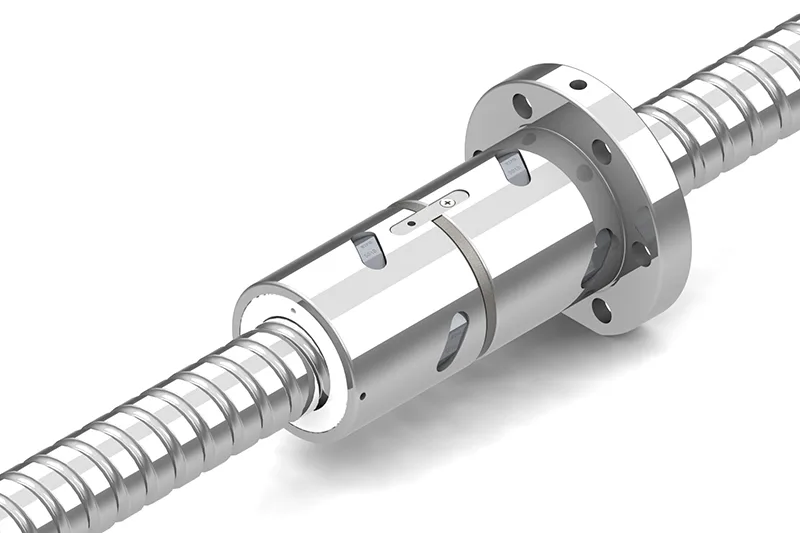
HJG-S Double Nut, External Return
Double-nut ball screw with an external return tube and spacer preload. Catalog symbols FYC1D (exposed tube) and FYC2D (enclosed tube). Ground C3/C5 and rolled C7.
- Catalog: FYC1D / FYC2D
- Diameter: 8–100 mm
- Accuracy: ground C3/C5, rolled C7

HJG-S Large-Lead Ball Screw
Large-lead HJG-S ball screw, catalog type FDL, for fast travel at lower driving power. Micro screws (Ø16 mm and below) are a separate type V (FV / FNYN), not FDL.
- Catalog: FDL (large lead)
- Diameter: 8–100 mm family
- Accuracy: ground C3/C5, rolled C7
How to Select the Right Ball Screw
Five key parameters to specify for optimal ball screw performance in your application
Nominal Diameter & Lead
Nominal diameter d0 and basic lead L0 are the first two digits of every HJG-S model number. Larger diameters carry higher axial load; lead sets linear speed (speed = lead × RPM). The catalog sizes start at 08 and the specification tables run to 160 mm, with leads from 2 mm on micro screws to 40 mm on the FDL large-lead type.
Accuracy — ground C3/C5 or rolled C7?
Published HJG-S supply is ground C3 and C5 plus rolled C7. In the catalog, travel variation over 300 mm (V300p) is 12 µm for grade 3 and 23 µm for grade 5. Use C3 or C5 on positioning axes and rolled C7 on transport axes.
Preload Class — Eliminate Backlash
The catalog lists no-preload construction with an axial play Δ of 0.005–0.30 mm, and three preloading ways: offset lead (B), spacer (D) and oversize ball (Z). Offset-lead preloading on the entire nut gives the greatest rigidity gain. Preload is normally Fp = Fmax / 3; where the axial preload cannot be defined, Fp = Ca × (8–10)%. Preload raises rigidity but too much of it shortens life and increases friction torque.
Nut Type — Single, Double, or Cylindrical?
The nut configuration is the letter before the diameter in the model code: cylindrical (Y), flange shape (F), micro shape (V), double flange and cylindrical (FY), and big lead (FDL). Single-nut constructions are FN, FC1 and FC2; double-nut constructions are FYND, FYC1D and FYC2D. A flange nut bolts directly to the support; a cylindrical nut is held in a housing.
End Machining & Support Bearings
The catalog specifies journal runout, axial slip of the supporting journal end face and the journal-to-supporting-journal runout. In precise machinery the catalog supports ball screws with combined thrust angular contact ball bearings, and the axial rigidity of those bearings enters the feed-system rigidity calculation. Send the end-machining drawing and the bearing arrangement with the inquiry.
Ball Screw Classification
Understanding the key design parameters and manufacturing methods helps you select the optimal ball screw for your specific application requirements.
Classification by Ball Recirculation Type
External Recirculation
Balls return to the starting end through an external tube or deflector mounted outside the nut body. This design allows for a larger number of ball circuits and higher load capacity. The return tube is typically made of hardened steel or engineering plastic for smooth transition.
Internal Recirculation
Balls recirculate inside the nut body through internal passages or deflectors, resulting in a compact and streamlined nut profile. The internal design reduces overall dimensions, making it suitable for applications with limited installation space.
Classification by Nut Design
| Nut Type | Description | Typical Series | Key Benefit |
|---|---|---|---|
| Single Nut | One nut body. Catalog single-nut constructions are FN, FC1 and FC2, with no preload or oversize-ball (Z) preload. | FN, FC1, FC2 | Compact, fewer parts |
| Double Nut (Preloaded) | Two nuts with spacer preload (D) between them, taking out axial play. | FYND, FYC1D, FYC2D | Axial play removed, higher rigidity |
| Flanged Nut | Flange shape, catalog letter F at the start of the model code. The flange carries the mounting holes. | FN, FC1, FC2, FYND | Direct bolt-on mounting |
| Cylindrical Nut | Cylindrical shape, catalog letter Y. The nut is held in an external housing or nut support. | Y-prefix symbols | Fits a bored housing |
Classification by Manufacturing Method
Ground Ball Screws
C3 / C5Ground screws are precisely ground and assembled and strictly inspected, which is what the catalog cites for the highest repeated positioning and driving accuracy. Travel variation is checked to GB/T 17587.3-1998.
- V300p: 12 µm for grade 3, 23 µm for grade 5
- Ideal for CNC machine tools, CMM, precision stages
- Series: HJG-S, all constructions
Rolled Ball Screws
C7Rolled C7 is the transport grade in the HJG-S published range. The catalog divides HJG-S into positioning (P) and travel (T) groups and sets seven accuracy grades — 1, 2, 3, 4, 5, 7 and 10 — to GB/T 17587.3-1998, grade 1 being the highest.
- Grade 7 in the catalog accuracy table
- Positioning (P) or travel (T) screw
- Series: HJG-S, all constructions
Industries We Serve
Luoyang Songju ball screws power precision motion across a diverse range of demanding industries worldwide.
CNC Machine Tools
Feed axes for machining centers, turning centers, grinding machines, and EDM. Ground C3/C5, rolled C7 screws ensure micron-level positioning accuracy for tight-tolerance machining.
Industrial Robots
Joint actuators for articulated robots, Cartesian gantry systems, and SCARA robots. High efficiency reduces motor size and energy consumption.
Semiconductor
Wafer handling stages, wire bonders, lithography positioning systems. Micro type V (FV, FNYN) for nominal diameter 16 mm and below.
Aerospace
Flight control actuators, landing gear mechanisms, satellite deployment systems. Ground C3/C5 screws where the axis needs the highest repeated positioning and driving accuracy.
Medical Devices
CT scanner patient tables, surgical robots, diagnostic positioning systems. Low friction torque and smooth travel on slow, precise axes.
Automotive
Electric power steering, brake-by-wire actuators, production line transfer systems. ground C3/C5, rolled C7 screws for high-precision, high-volume applications.
Printing & Packaging
Print head positioning, die-cutting presses, labeling machines. Flange-shape nuts (letter F in the code) bolt straight to the support.
Laboratory Automation
Liquid handling robots, sample positioning stages, microplate readers. Micro type V screws with a nominal diameter of 16 mm or less.
HJG-S Construction Guide
HJG-S is one ball-screw family. Pick the construction from the catalog symbol; sizes and rated loads are in the specification table for each type.
| Construction | Catalog symbols | Recirculation | Preload shown for these symbols | Nut | Typical use |
|---|---|---|---|---|---|
| Type C1 — exposed tube | FC1, FC1B, FC1(Z) | External tube | None, offset lead (B), oversize ball (Z) | Single | Notch allowed in the nut support; FC1B for short radial and axial size |
| Type C2 — enclosed tube | FC2, FC2B, FC2(Z) | External tube, inside the nut OD | None, offset lead (B), oversize ball (Z) | Single | No notch in the nut support; larger radial size |
| Type N — curved deflector | FN, FN(Z) | Internal deflector | None, oversize ball (Z) | Single | Compact radial size, higher resistance to vibration, lower speed limit |
| Double nut, external tube | FYC1D, FYC2D | External tube | Spacer (D) | Double | Preloaded external-return axes |
| Double nut, internal deflector | FYND | Internal deflector | Spacer (D) | Double | Preloaded compact axes |
| Large lead | FDL | Per the FDL table | Per the FDL table | Single | Rapid travel with lower driving power |
| Micro (d0 ≤ 16 mm) | FV, FNYN | Internal | Per the micro table | Single | Small radial dimensions, light mechanisms |
Need Help Selecting a Ball Screw?
Our application engineers provide free technical consultation, 3D CAD models, sizing calculations, and competitive quotations. Tell us your application requirements and we will recommend the optimal ball screw series.
Ball Screw FAQ
What accuracy grades do Songju ball screws come in?
HJG-S is supplied as ground C3 and C5 and rolled C7, to DIN 69051. Catalog V300p is 12 µm for grade 3 and 23 µm for grade 5.
What is the difference between internal and external return ball screws?
Internal return is the curved deflector, type N (symbols FN, FN(Z); double nut FYND). The catalog describes it as widely used in Europe, America and Japan, with a higher ability against vibration and high positioning accuracy; its dimensions match type C1 but the limited speed is lower, and it costs a little more. External return is the tube type: C1 (FC1, FC1B) has the tube standing outside the nut and needs a notch in the nut support; C2 (FC2, FC2B) keeps the tube within the nut outside diameter so no notch is needed, at a larger radial size.
What preload options are available?
The catalog lists three preloading ways: offset lead (B), spacer (D) and oversize ball (Z). Spacer preload (D) is used on the double-nut constructions FYND, FYC1D and FYC2D; oversize ball (Z) and offset lead (B) appear on single-nut symbols. Offset lead preloading on the entire nut gives the greatest rigidity gain. Preload is normally Fp = Fmax / 3, or Fp = Ca x (8–10)% when the axial preload cannot be defined.
How do I calculate ball screw life expectancy?
The catalog gives run life L = (Ca / (fw x Fa))^3 x 10^6 revolutions, where Ca is the rated dynamic load, Fa the axial load and fw the load factor (1.0–1.2 smooth running, 1.2–1.5 common running, 1.5–2.5 with impact); time life follows as Lh = L / (60n). The expected working hours in the catalog are 20,000 h for CNC and precision machine tools, 10,000–15,000 h for common machine tools and 5,000–10,000 h for common machinery. Send the load cycle and we will run the calculation.
Get a Competitive Quotation
Fill out the form below and our engineering team will respond within 24 hours with pricing and technical documentation.
Explore More Products
Browse our full range of precision components
Related Guides
Technical resources to help you specify and select
Precision Ball Screw Selection Guide
Ground vs rolled, accuracy grades, preload, and lead selection for CNC axes.
Technical GuideHJG-S Accuracy: Ground C3/C5 and Rolled C7
When ±5 μm lead error beats ±50 μm — comparison and per-axis grade selector.
Technical GuideGround vs Rolled Ball Screws Guide
Accuracy, cost, and application trade-offs between ground and rolled screws.