
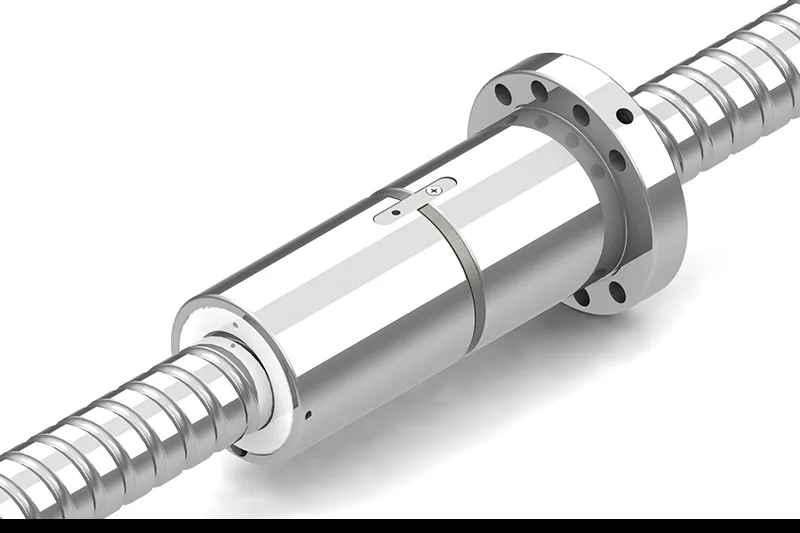
The ball screw is one of the most critical motion control components in a CNC machine tool — converting rotary motion from the servo motor into precise linear movement of the table or spindle head. Selecting the wrong ball screw leads to positioning errors, premature wear, thermal drift, and ultimately scrap parts. This guide covers the key factors engineers must evaluate: manufacturing method (ground vs. rolled), accuracy grade (C2 through C7), preload and rigidity, lead selection, and application-specific considerations.
Ground vs. Rolled Ball Screws: The Manufacturing Divide
The fundamental choice starts at the manufacturing method. Each process produces fundamentally different accuracy and cost characteristics:
Ground ball screws are manufactured by precision grinding the screw thread after heat treatment. The grinding process achieves superior accuracy because the thread profile is generated by a CNC grinding wheel whose position is controlled to sub-micron precision. Ground screws achieve lead accuracy of ±0.003 mm per 300 mm (C2 grade) and surface roughness below Ra 0.2 μm. The trade-off is cost — grinding is a slow, single-point process, and each screw may require 30–60 minutes of grinding time depending on diameter and length. Ground screws are essential for applications requiring positioning accuracy below 10 μm, including machining centers, grinding machines, and semiconductor equipment.
Rolled ball screws are formed by cold rolling the thread profile into the screw blank using rotating forming dies. The process is fast — a screw can be rolled in under a minute — and produces a work-hardened thread surface with good fatigue resistance. However, rolled screws are inherently less accurate because the forming dies introduce pitch variation as they wear, and there is no post-process correction. Typical rolled screw accuracy is ±0.023 mm per 300 mm (C5–C7 grades). Rolled screws are well-suited for general automation, material handling, woodworking CNC routers, and applications where positioning accuracy of 20–50 μm is acceptable.
| Characteristic | Ground Ball Screw | Rolled Ball Screw |
|---|---|---|
| Lead Accuracy (per 300 mm) | ±0.003 mm (C2) | ±0.020–0.050 mm (C5–C7) |
| Surface Roughness (Ra) | 0.1–0.2 μm | 0.4–0.8 μm |
| Production Speed | 30–60 min per screw | <1 min per screw |
| Relative Cost | 3×–8× higher | Baseline |
| Max Available Length | ~6,000 mm | ~4,000 mm |
| Best Applications | Machining centers, grinders, CMMs | Woodworking routers, pick-and-place, general automation |
Understanding Ball Screw Accuracy Grades
Ball screw accuracy is classified using the C-grade system defined in ISO 3408-3 and JIS B1192 standards. Each grade specifies the permissible variation in lead over different measurement lengths:
| Grade | Lead Deviation (μm/300 mm) | Typical Application | ISO Equivalent |
|---|---|---|---|
| C2 | ±3 | Jig boring machines, CMMs, optical grinders | ISO P2 |
| C3 | ±6 | Precision machining centers, CNC lathes | ISO P3 |
| C5 | ±18 | General CNC mills, EDM machines | ISO P5 |
| C7 | ±50 | Woodworking routers, material handling | ISO P7 |
For most CNC machine tool builders, C3 is the sweet spot — it provides sufficient accuracy for precision machining (typically better than 10 μm positioning over 300 mm travel) without the significant cost premium of C2. Luoyang Songju manufactures ground ball screws in C2 and C3 grades, with full inspection reports documenting lead deviation, ball track geometry, and preload drag torque for every screw shipped.
Preload Methods: Eliminating Backlash
Backlash — the lost motion when reversing direction — is unacceptable in CNC machine tools because it introduces hysteresis into the servo control loop. Preload eliminates backlash by applying an internal axial force that ensures the ball nut and screw maintain contact in both directions.
The two dominant preload methods are:
Double-nut preload uses two nuts separated by a precisely ground spacer or shim. The spacer thickness determines the preload magnitude — typically 5–8% of the dynamic load rating (Ca) for most machine tool applications. This method provides the highest rigidity because the load is distributed across two separate ball circuits. It also allows preload adjustment during assembly by changing the spacer thickness. The trade-off is increased nut length and cost. Double-nut designs are standard on machining centers and grinding machines where rigidity under interrupted cutting loads is critical.
Oversized-ball preload uses balls that are slightly larger than the nominal track diameter in a single nut, creating a controlled interference fit. The preload is generated by the elastic deformation of the balls as they travel through the circuit. This method produces a more compact assembly but the preload cannot be adjusted after manufacture, and preload consistency depends on tight ball diameter tolerance — typically sorted to within ±1 μm. Oversized-ball preloading is common in space-constrained applications like vertical machining center Z-axes and lathe cross-slides.
In both cases, the preload force should be verified by measuring the dynamic drag torque under no-load conditions. The measured torque should be 1.5–2.5× the no-preload torque specification, and the variation should be less than ±15% over the full travel length. A sharp spike in drag torque at any position indicates a localized lead error or contamination in the ball track.
Lead Selection: Speed, Resolution, and Thrust
The lead — the linear distance the nut travels per revolution — is a critical design parameter that balances three competing requirements:
- Rapid traverse speed: Larger leads produce higher linear speeds for a given motor RPM, reducing non-cutting time. For modern machining centers targeting 48–60 m/min rapids with 3,000 RPM servos, a 16 mm or 20 mm lead is typical.
- Positioning resolution: Smaller leads produce finer resolution per encoder pulse. A 10 mm lead with a 1,048,576-count encoder yields 0.01 μm theoretical resolution, versus 0.02 μm for a 20 mm lead. In practice, the servo stiffness and mechanical compliance dominate at this level.
- Axial thrust capacity: The relationship between motor torque (T), lead (L), and thrust (F) is: F = 2π × T × η / L, where η is the screw efficiency (~90% for ball screws). A smaller lead multiplies motor torque into greater axial force — making it preferable for heavy cutting applications.
For most CNC machine tools, leads of 10 mm (milling machines) and 12–16 mm (machining centers) provide an effective balance. High-speed machines optimized for aluminum cutting may use 20–32 mm leads. Precision grinding machines typically use 5–6 mm leads to maximize resolution and thrust.
Lubrication and Life Considerations
Ball screw service life depends heavily on lubrication quality and contamination control. ISO 3408-5 defines the basic rating life L₁₀ (90% reliability, million revolutions): L₁₀ = (Ca/Fm)³ × 10⁶, where Ca is the dynamic load rating and Fm is the mean equivalent load. In practice, actual life is extended 2–5× beyond L₁₀ when using lithium-soap grease with EP additives, applied through automatic lubrication systems at intervals of 500–1,000 operating hours. For oil-lubricated screws in high-speed applications, oil-air mist systems delivering ISO VG 32–68 oil at 0.03–0.1 cm³ per hour per circuit provide optimal film thickness without overheating.
Bellows or telescopic covers are strongly recommended for any ball screw in a machining environment. Even with wiper seals on the nut, fine chips and coolant mist can bypass the seals and cause spalling or brinelling of the ball tracks — a failure mode that cannot be repaired and requires complete screw replacement.
Luoyang Songju Ball Screws: C2/C3 Ground Precision
Luoyang Songju manufactures ground precision ball screws in diameters from 8 mm to 100 mm, with leads from 4 mm to 40 mm. All screws are produced to C2 or C3 accuracy grade, with full inspection reports and dynamic drag torque measurements. Our double-nut preloaded assemblies provide zero-backlash performance for demanding CNC machine tool applications. Choose from standard FCD, FC, FY, FYD, and FYB series — or contact our engineering team for custom specifications including special end machining, keyway cutting, and bearing journal grinding. ISO 9001:2015 certified.
Selection Checklist
When specifying a ball screw for a CNC machine tool axis, work through these questions:
- What positioning accuracy is required? → Choose grade: C2 for <5 μm, C3 for 5–10 μm, C5 for 10–50 μm.
- What are the maximum axial cutting and acceleration forces? → Select screw diameter to keep stress below 10% of static load rating (Coa).
- What is the target rapid traverse speed? → Calculate required lead: Lead ≤Vmax / Nmax (motor). Consider D×N limit for critical speed.
- Is backlash acceptable? → If no, specify preloaded nut (double-nut or oversized-ball). Verify drag torque uniformity.
- What is the stroke length? → Screws over 1,500 mm may require tensioning to prevent thermal growth and sag. Check critical speed for screw diameter.
- What is the operating environment? → Specify bellows covers, positive-pressure air purge, or IP-rated nut seals for wet/dirty conditions.
Selecting the right ball screw is an engineering decision with direct impact on machine accuracy, productivity, and service life. By carefully evaluating manufacturing method, accuracy grade, preload method, lead, and environmental protection, machine builders can achieve positioning performance that meets or exceeds their design targets while controlling cost.