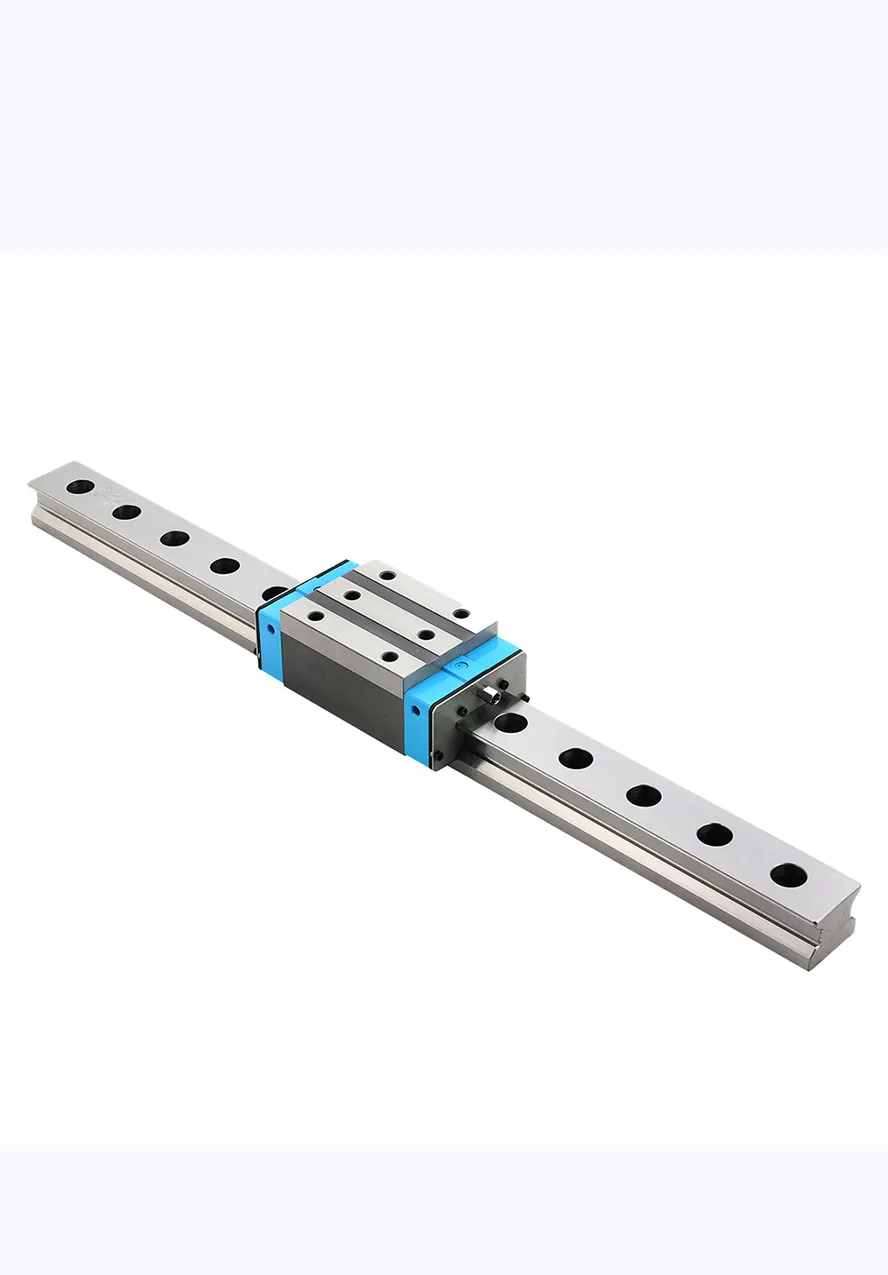
Linear guideways are the backbone of precision motion in CNC machine tools — constraining motion to a single axis while carrying heavy cutting loads with micron-level straightness. Selecting the correct guideway and installing it properly determines whether a machine tool meets its geometric accuracy specifications (straightness, flatness, squareness) or drifts into misalignment that produces tapered and out-of-tolerance parts. This guide covers precision grade selection, preload class matching, installation alignment procedures, and lubrication strategy — the four pillars of linear guideway performance.
Precision Grades: P, H, and SP — What They Mean
Linear guideway precision is classified by the tolerance on dimensional and running accuracy. The three most common grades for CNC applications are:
| Grade | Height Tolerance H (±μm) | Width Tolerance W2 (±μm) | Parallelism (μm) | Typical Application |
|---|---|---|---|---|
| SP (Super Precision) | ±10 | ±10 | 3–5 | Jig grinders, CMMs, optical inspection |
| P (Precision) | ±20 | ±20 | 5–8 | Precision machining centers, CNC lathes |
| H (High) | ±40 | ±40 | 12–15 | General CNC mills, EDM, welding robots |
For most CNC machine tool builders, P-grade is the standard starting point. It provides running parallelism within 5–8 μm across the full rail length, which is sufficient for positioning accuracy in the 5–10 μm range — the sweet spot for machining centers. The jump to SP-grade adds significant cost but is mandatory for ultra-precision applications where the linear guideway must not be the limiting factor in the machine's overall geometric accuracy budget. H-grade rails are used where the dominant accuracy limitation comes from the machine structure itself (e.g., welded steel frames for woodworking CNC routers) rather than the linear components.
Preload Classes: Z0, Z1, Z2, Z3 — Rigidity and Friction Balance
Preload in a linear guideway is created by fitting balls or rollers with a controlled interference between the rail and block raceways. Higher preload increases rigidity and reduces deflection under load, but also increases rolling friction and heat generation. The four standard preload classes are:
| Class | Clearance/Preload | Rigidity Gain vs. Z0 | Rolling Resistance | Application |
|---|---|---|---|---|
| Z0 (Light Clearance) | +3 to +12 μm | Baseline | Very low | Manual slides, light automation |
| Z1 (Zero / Light Preload) | −2 to +3 μm | ~1.3× | Low | General CNC, EDM, 3D printers |
| Z2 (Medium Preload) | −6 to −2 μm | ~1.7× | Moderate | Machining centers, heavy milling |
| Z3 (Heavy Preload) | −10 to −6 μm | ~2.2× | High | High-stiffness grinders, broaching |
The preload class selection follows a simple rule: match preload to the maximum load-induced deflection you can tolerate. A Z2-preloaded LGR-series roller guideway deflects approximately 0.3–0.5 μm/kN — meaning a 5 kN cutting force produces about 2 μm of deflection. This is negligible for roughing operations but may be significant in finish passes requiring sub-micron form accuracy, where Z3 preload or a switch to roller-type guideways should be considered. The trade-off is measurable: Z3-preloaded guideways run 5–8°C hotter than Z1 at high speeds due to increased rolling friction, which must be accounted for in the machine's thermal compensation model.
Ball Type vs. Roller Type vs. Ball Chain
Three rolling element configurations are available, each with distinct performance profiles:
Ball-type guideways (LGS, LG, LSQ series) use recirculating steel balls. They offer the lowest rolling friction and are suitable for applications up to moderate loads (dynamic load rating typically 10–80 kN per block). Ball guideways are the most common choice for general CNC machining because they provide an excellent balance of rigidity, speed capability (up to 120 m/min), and life. The four-point contact geometry ensures consistent stiffness in all load directions.
Roller-type guideways (LGR series) replace balls with cylindrical rollers, increasing the contact area by approximately 3–5×. This dramatically increases both static and dynamic load ratings — roller blocks in the same envelope typically carry 1.5–2.5× the load of ball blocks. Roller guideways are specified for heavy-duty machining centers, horizontal boring mills, and applications with high cantilevered loads where ball guideways would experience excessive elastic deformation. The penalty is higher friction and lower speed capability — typical maximum speeds are 60–80 m/min versus 120+ m/min for ball types.
Ball chain guideways (LGSW series) incorporate a plastic chain or cage that separates each ball, preventing ball-to-ball contact. This eliminates the friction and noise generated when adjacent balls collide at the entrance of the recirculation path — a phenomenon that becomes significant above 60 m/min. Ball chain designs also retain lubricant more effectively, extending re-lubrication intervals by 2–3×. They are the preferred choice for high-speed machining applications where rapid traverse rates exceed 60 m/min.
Installation: Rail Mounting and Alignment
Even the highest-grade linear guideway will perform poorly if installed with inadequate alignment. The two critical installation parameters are:
1. Rail parallelism. The reference rail (usually the fixed-side rail on the datum shoulder) is installed first and aligned to the machine's axis of motion. The secondary rail is then aligned parallel to the reference rail. For P-grade guideways, the parallelism between rails should be within 15 μm over the full length. This is achieved by:
- Mounting the reference rail against a precision-ground datum shoulder on the machine bed casting.
- Using a dial indicator on the secondary rail while traversing the reference rail block along its full stroke.
- Tightening mounting bolts in sequence from center outward at the specified torque (typically 30–50 N·m for M8 bolts on 35–45 mm rail sizes).
2. Rail flatness and straightness. The mounting surface itself must be flat to within 10 μm per 500 mm for P-grade rails. Any deviation in the mounting surface is transmitted directly into the rail as a geometric error. Cast iron machine beds should be hand-scraped or precision ground after stress relieving. Welded steel fabrications require stress relief annealing before finish machining of the rail mounting surfaces. For field installations where grinding is impractical, epoxy-based leveling compounds (e.g., DWH 310 FL) can achieve flatness below 10 μm/m when applied to properly prepared surfaces.
3. Bolt torque and tightening sequence. Uneven bolt torque creates local rail deformation — a 20% variation in torque between adjacent bolts can produce a 3–5 μm local dip in the rail surface height. All bolts should be tightened to the manufacturer's specified torque using a calibrated torque wrench, in a sequence that starts from the center of the rail and alternates outward. After 24 hours of operation, all bolts should be re-torqued to compensate for initial relaxation of the joint.
Lubrication: The Lifeblood of Linear Guideways
Adequate lubrication is the single most important factor in achieving rated guideway life. The primary failure mode of linear guideways is surface-origin spalling — microscopic cracks initiated at asperity contacts where the lubricant film has broken down, which propagate under repeated rolling contact until a pit forms. Proper lubrication maintains an elastohydrodynamic (EHD) film that physically separates the ball or roller from the raceway.
For CNC machine tools, lithium-soap grease with EP (extreme pressure) additives, NLGI Grade 1–2, is the standard choice. Grease quantities should be calculated based on the guideway size:
- 15–25 mm rail: 0.5–1.0 cm³ per block per re-lubrication
- 30–45 mm rail: 1.5–3.0 cm³ per block per re-lubrication
- 55–65 mm rail: 4.0–6.0 cm³ per block per re-lubrication
Re-lubrication intervals depend on speed and environment: under clean conditions at moderate speeds (<60 m/min), greasing every 500–1,000 km of travel or every 3–6 months (whichever comes first) is typical. For high-speed applications with ball chain blocks, the interval can be extended to 2,000–3,000 km. In wet or contaminated environments (grinding shops, foundries), intervals should be halved and the blocks should be equipped with double-lip or contact seals with positive-pressure air purge.
Luoyang Songju Linear Guideways: P/H/SP, 15–65 mm Rails
Luoyang Songju manufactures a complete range of linear guideways in rail sizes from 15 mm to 65 mm, covering ball-type (LGS, LG, LSQ), roller-type (LGR), wide-type (LGSW), and crossed roller (CS) configurations. All guideways are available in P, H, and SP precision grades with Z0 through Z3 preload classes. Each block is assembled in a controlled cleanroom environment and undergoes 100% running smoothness inspection before shipment. Custom rail lengths, special coatings (black chrome, nickel plating), and complete axis assemblies with matched rails and blocks are available. ISO 9001:2015 certified.
Application Selection Guide
| CNC Application | Recommended Type | Grade | Preload | Rail Size |
|---|---|---|---|---|
| 3-axis VMC (mild steel) | Ball (LGS) — 4-block per axis | P | Z2 | 35–45 mm |
| 5-axis machining center | Roller (LGR) — X/Y axes | P | Z2–Z3 | 45–55 mm |
| High-speed VMC (Al cutting) | Ball Chain (LGSW) | P | Z1 | 30–35 mm |
| CNC lathe (slant bed) | Ball (LGS) — X + Z axes | P | Z2 | 30–35 mm |
| Cylindrical grinder | Ball (LGS) — matched pairs | SP | Z2 | 25–30 mm |
| Woodworking CNC router | Ball (LG) | H | Z1 | 20–25 mm |
| Robotic 7th axis / gantry | Ball (LGS) — extended blocks | H | Z0–Z1 | 25–35 mm |
Installation Checklist
Before commissioning a linear guideway axis, verify:
- Mounting surface flatness verified with a precision level or laser interferometer — within 10 μm/500 mm for P-grade.
- Datum shoulder straightness confirmed with dial indicator along full length.
- Rail parallelism measured at both ends and center — within 15 μm for P-grade.
- Bolt torque verified at every position — no skipped or undertorqued bolts.
- Block running smoothness checked by traversing each block manually — no catches, clicks, or tight spots.
- Lubrication system functional — grease exits at all nipples before final assembly.
- End seals and wipers installed — verify that scraper plates contact the rail surface on both sides.
- Full-stroke cycling for 30 minutes at low speed — then re-check bolt torque and rail parallelism.
Linear guideway selection and installation is a discipline where attention to detail directly determines machine accuracy and longevity. By matching precision grade, preload class, and rolling element type to the application, and following rigorous installation procedures, machine builders can consistently achieve geometric accuracy within 5–10 μm — the standard expected of modern CNC machine tools.