Short answer: P4 (ABEC-7) is the standard choice for CNC machine tool spindles; step up to P2 (ABEC-9) only when runout is the limiting factor — grinding spindles, very high speeds, or metrology duties. P4 delivers the accuracy that conventional machining centers, milling, and turning spindles actually use, at baseline cost. P2 buys sub-micron running accuracy — radial runout as low as 0.001 mm in Songju production — for applications where the spindle's error budget directly becomes the workpiece's surface finish. Here is the attribute-level comparison, an application selector, and what is available in our P5/P4/P2 range.
Precision Bearings for CNC Spindle — Quick Selector
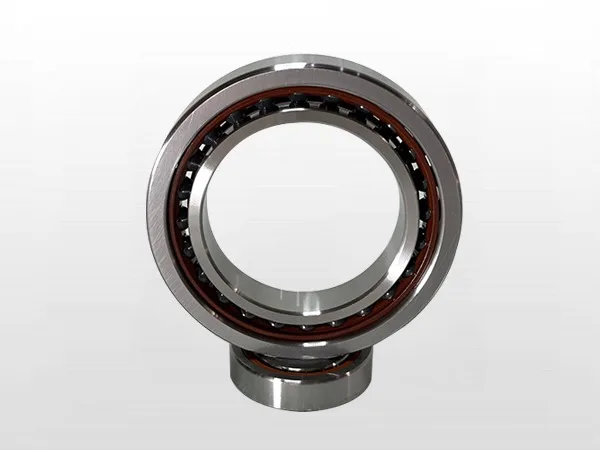
If you landed here looking for precision bearings for a CNC spindle, start with three decisions: bearing type (usually angular contact at the locating end), ISO grade (P4 for most machining/milling/turning; P2 when grinding or metrology makes runout the limit), and matched arrangement (DB / DF / DT with a stated preload). Songju supplies P5/P4/P2 angular contact and related spindle bearings under ISO 9001:2015 manufacturing; P2 running accuracy can reach 0.001 mm radial runout in production. Use the checklist below, then open the angular-contact product page or send duty data via Contact — lead time and MOQ confirm with sales.
CNC spindle precision-bearing checklist:
- Locating-end type — angular contact ball bearing (15° speed / 25° rigidity).
- Grade — P4 default; P2 only if process runout/surface finish demands it (see tables above).
- Arrangement + preload — DB / DF / DT or tandem-O; Light / Medium / Heavy as one matched set.
- Series envelope — 718 / 719 / 70 / 72 to fit housing and load (principle overview on the angular-contact article).
- Lubrication & max RPM — grease vs oil-air; do not mix catalog speed columns.
- Floating end — often a P4 cylindrical roller so axial growth is free.
- RFQ packet — bore/OD, designation, speed, load direction, OEM spindle model → /contact.
Next: Angular contact ball bearings · Angular contact bearings for spindle (guide) · Precision bearings · Contact
P4 vs P2: Attribute Comparison
| Attribute | P4 (ABEC-7) | P2 (ABEC-9) |
|---|---|---|
| Tolerance system | ISO 492 class 4 | ISO 492 class 2 |
| Role | The working standard for machine-tool spindles | The ultra-precision class above it |
| Radial runout | Tight running accuracy per the ISO 492 P4 table | As low as 0.001 mm in our production |
| Typical duty | Machining center, milling and turning spindles | Grinding spindles, high-speed machining, metrology |
| Relative cost | Baseline | Premium — buy it only when runout is the limit |
| Steel and treatment | GCr15 with dimensional stability treatment | GCr15 with dimensional stability treatment |
Both grades share the same GCr15 bearing steel with dimensional stability treatment, so the decision is purely about tolerance class and what your application can exploit. A useful mental model: P4 makes the spindle good; P2 makes the spindle disappear from the error budget. Grinding is the classic P2 case — the wheel edge reproduces spindle runout directly into the workpiece surface. High internal grinding speeds (up to 120,000 RPM in small-diameter wheels) amplify even micron-level errors, which is why P2 dominates there.
Application Selector: Which Grade Where
| Application | Recommended grade | Why |
|---|---|---|
| Machining center spindle (milling) | P4 | Meets positioning and surface finish targets at standard cost |
| Turning / milling spindle | P4 | High radial rigidity with P4 cylindrical rollers at the floating end |
| External / internal grinding spindle | P2 | Grinding wheel edge finish tracks spindle runout — sub-micron pays for itself |
| High-speed motorized spindle (up to 120,000 RPM) | P4, P2 by speed | Higher speeds amplify even micron-level imbalance and runout |
| Inspection and measuring equipment | P2 | The spindle must not be the measurement error budget |
When in doubt, start with P4 and let the process data argue for P2: if finished-part roundness or surface Ra cannot be met while everything else is ruled out, spindle runout is the suspect and P2 is the fix. Downgrading later is always cheaper than over-specifying now — but note that rebuilds with mixed grades are not recommended; a set should be uniform.
What Songju Offers in P5/P4/P2
- Angular contact ball bearings — 718, 719, 70, and 72 series; 15° (C, high-speed) and 25° (AC, high-rigidity) contact angles; bores 35–280 mm; universal-face ground for DB/DF/DT matched sets; phenolic, PEEK, or machined brass cages.
- Cylindrical roller bearings — NN, NNU, and N types in P4 for the non-locating (floating) end of spindle arrangements, 25–500 mm bore, optimized roller profile for high radial rigidity at speed.
- Crossed roller bearings — CRBT, CRBH, RA, RB, RE, RU series, 10–800 mm bore, for rotary tables, indexing heads, and robot joints.
- Thrust ball bearings — 511 through 533 series, 10–500 mm bore, for vertical shafts and axial positioning.
All grades ship with inspection reports; matched sets are labeled by arrangement type and preload class so rebuilds return the spindle to its original specification. Send us your current bearing designation and duty — our engineers confirm the equivalent grade and quote within 24 hours.
Frequently Asked Questions
Can I replace P4 bearings with P2 in an existing spindle?
Physically the envelopes match within the same series, so P2 can substitute P4 where the extra accuracy helps - grinding and high-speed spindles benefit most. It rarely makes sense on general milling and turning spindles: you pay a premium for accuracy the application cannot use, and delivery is typically longer.
Is P4 the same as ABEC-7?
Functionally yes for spindle selection purposes. P4 is the ISO/DIN tolerance class; ABEC-7 is the ANSI/ABMA equivalent. Songju angular contact spindle bearings are produced to P5/P4/P2 with the ABEC-5/7/9 equivalents stated on every datasheet, so both naming systems can be quoted against.
Why do matched sets (DB, DF, DT) matter at these grades?
P4 and P2 angular contact bearings are universal-face ground, which means any bearing can be mounted against any other in DB (back-to-back), DF (face-to-face) or DT (tandem) arrangements with predetermined preload. This lets one stock item serve multiple spindle designs and keeps set preload consistent after rebuilds.
What is the lead time for P4 and P2 bearings?
Standard-series P4 angular contact bearings (15 or 25 degree contact angle, 35-280 mm bore) ship within 2-4 weeks; P2 and matched-set orders are quoted individually. Every shipment includes an inspection report, and pre-shipment inspection video on request.