
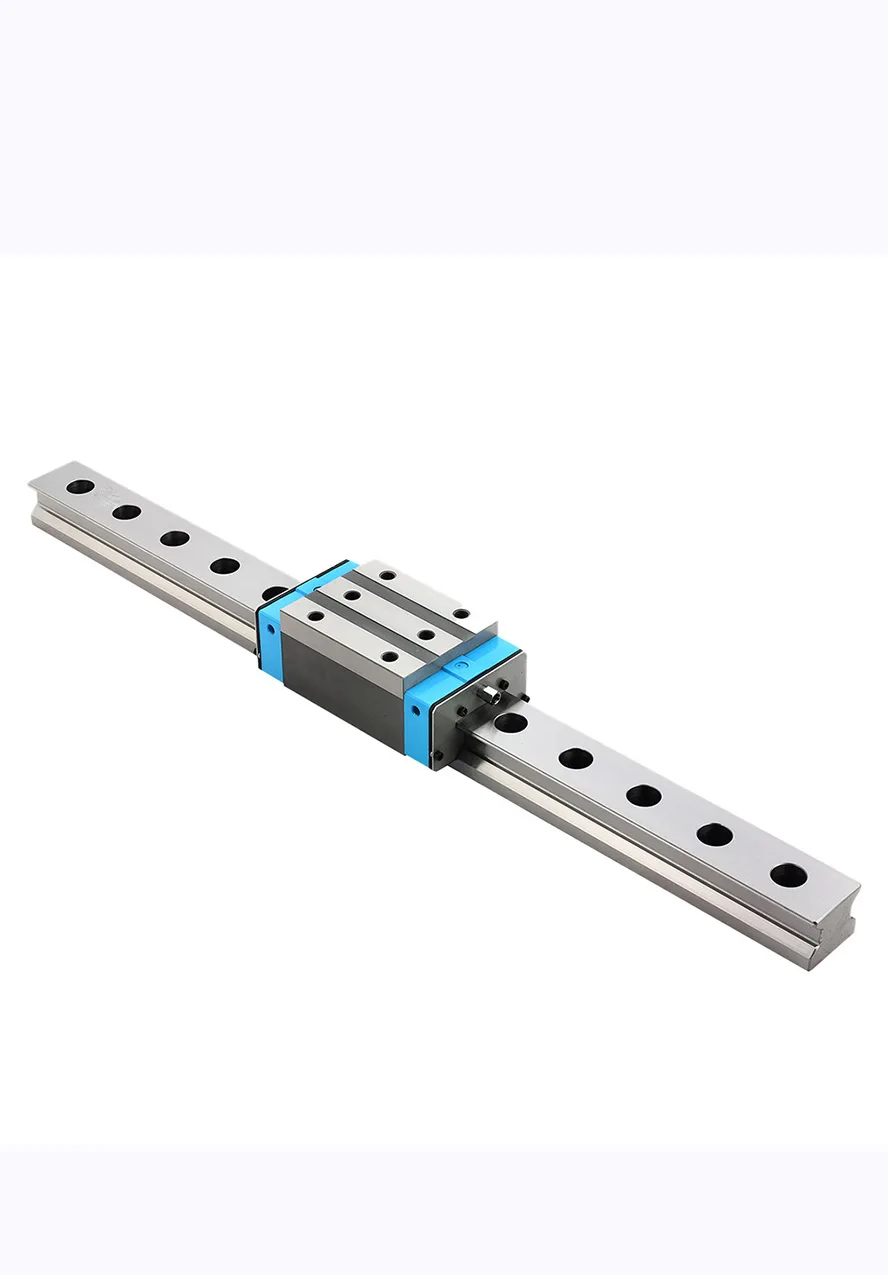
When a rail wears out, buyers often ask for a “drop-in” HIWIN, THK, or NSK alternative. The phrase is useful only if mounting geometry, carriage form, accuracy class, and preload are locked before the RFQ. This checklist is written for purchasing and maintenance teams that need a replacement that bolts onto an existing machine bed—without treating brand letter codes as if they were universal.
For Songju’s four-row ball series and size-by-size cross-reference tables, start with the product page for linear guideways and the companion HIWIN / THK / NSK interchange guide. This article focuses on the buyer workflow, not a second copy of the dimension tables.
What “drop-in” actually means
In linear motion, “drop-in” means the replacement set matches the mounting envelope of the installed system so the machine bed and table do not need re-machining. At minimum, compare:
- Rail width (nominal size) — for example 15, 20, 25, 30, 35, 45 mm and larger sizes where the machine uses them.
- Rail mounting hole pitch and hole pattern — bolt centers along the rail and distance from the rail reference edge.
- Carriage height and length — overall height from rail bottom to carriage top, and carriage body length that affects bolt pattern and overhang.
- Carriage mounting bolt pattern — M-thread size, pitch, and location relative to the carriage centerline.
- Accuracy grade and preload — these change fit, stiffness, and drag; matching only the size letter is not enough.
Brand letters (HG, SHS, HSR, LH, and so on) are shortcuts, not proof of interchange. Two carriages can share a nominal width and still differ in height, seal package, or preload. Treat drop-in as a dimension-and-class match, confirmed against the part number on the carriage end face—not as a claim that every model in a catalog family swaps 1:1.
Collect these fields before you RFQ
Send a complete packet once. Incomplete RFQs usually bounce back for photos of the end-face code or a tape measure of rail width. Collect:
- Current brand and series — HIWIN HG / HGW (and related HGH/HGR naming on drawings), THK SHS / HSR, NSK LH, or another OEM mark printed on the carriage.
- Full model code — for example HGW25CC, SHS25C, LH25; photograph the end face if the stamp is worn.
- Rail width (mm) and rail length (or cut length required).
- Carriage form — flange or square/block style; number of carriages per rail; top-mount vs bottom-mount if marked.
- Accuracy class — P / H / SP or the original maker’s letter/number grade. Grades are not standardized across brands; when possible, attach a tolerance table page or the inspection value you need.
- Preload — light / medium / heavy, or the maker’s preload code if known.
- Lubrication and seals — grease type preference, end-seal style, scrapers, or cover strip if used.
- Quantity, ship-to, and required lead time — plus whether rails and carriages must ship as matched sets (recommended).
Optional: machine type, axis, duty, and whether the bed machining must stay untouched.
Map to Songju HJG-D
Songju’s four-row ball family (HJG-D / HJG-DA) follows the same international mounting conventions used by common HIWIN HG/HGW, THK SHS/HSR, and NSK LH mid-width sizes. Select accuracy (P/H/SP) and preload (H0–H3) for the axis—do not assume competitor letters map 1:1.
How to use the mapping without guessing:
- Confirm nominal rail width and carriage style from the installed part.
- Open the interchange guide for the size-by-size cross-reference (for example HJG-DA 25 vs HG 25 / SHS 25 / HSR 25).
- Ask Songju to confirm the exact HJG-D equivalent against your end-face code before PO—especially for legacy HSR drawings, special seals, or non-standard rail hole pitch.
- Order rails and carriages as matched sets. Mixing one brand’s rail with another brand’s carriage is not supported, even when bolt patterns look similar, because raceway geometry and ball pitch must match.
The public cross-reference covers common 15–45 mm widths; fuller width tables live on the linear guideway catalog page—verify your size there.
Accuracy and preload pitfalls
Interchange failures are rarely “the wrong width.” They are usually the wrong accuracy or preload for the axis:
- Accuracy too loose — positioning scatter, visible scrape marks on finishing passes, or inspection fail on a previously stable axis.
- Accuracy tighter than the machine can use — higher cost and longer lead time with no measurable process gain if the bed, ball screw, or thermal environment dominates the error budget.
- Preload too light — lost stiffness, vibration under cutting or rapid traverse, shorter practical life under moment load.
- Preload too heavy — excess drag, heat, noisy running, and harder manual assembly on long rails.
Grade letters differ by brand. Compare tolerance values rather than assuming “H” or “P” means the same thing. If the datasheet is missing, state the process need and ask engineering for a class.
Installation notes buyers forget
A correct part number still fails if installation basics are skipped. These are buyer reminders, not a substitute for the site installation manual:
- Reference edge and datum — seat the rail against the machined reference shoulder; do not “float” both sides and torque randomly.
- Cleanliness — chips, paint, or leftover Loctite under the rail soleplate create local high spots that look like “bad accuracy.”
- Bolt torque and sequence — follow the catalog torque; tighten from the center outward on long rails; re-check after initial travel.
- Parallelism of dual rails — measure and correct before loading carriages; forcing a carriage onto a misaligned pair damages raceways.
- Lubrication at first run — confirm grease or oil-air ports are open and filled as specified for the seal package you ordered.
- Do not mix brands on one axis — one rail brand + another carriage brand is not a drop-in strategy.
For selection context beyond replacement, see the linear guideway selection and installation guide.
RFQ template (copy/paste)
Copy into your email and fill every line you can:
Subject: Linear guide drop-in RFQ — [machine / axis]

- Current brand / series / full model code:
- Photo of carriage end face: (attached)
- Rail width (mm) / rail length (mm) / quantity of rails:
- Carriages per rail / carriage type (flange or square) / quantity:
- Accuracy class (or measured need):
- Preload code or description:
- Lubrication / seal notes:
- Must keep existing bed machining? (yes/no)
- Target delivery date / ship-to country:
- Application (one sentence):
Send to jin@luoyangsongju.com. We confirm the HJG-D equivalent against your code, then quote price and lead time by size, accuracy, and preload.
Call to action
Need a drop-in set for HIWIN, THK, or NSK geometry? Email the template above to jin@luoyangsongju.com, or browse Songju linear guideways and the size cross-reference first.
Frequently Asked Questions
Is every HIWIN HG size a 100% swap for Songju HJG-D?
No. At matching nominal widths, mounting dimensions are designed to follow the same conventions, but accuracy, preload, seals, and special hole pitches must be confirmed against your part number. We do not claim universal interchange for every catalog variant.
Can I keep my old carriages and only replace the rail?
No. Rails and carriages should be ordered as matched sets from the same maker. Mixing brands is not supported.
What if my brand is not HIWIN, THK, or NSK?
Send the end-face model code, rail width, and photos. Engineering will compare mounting dimensions to the HJG-D tables where possible.
Do I need the highest accuracy grade for every axis?
No. Match grade and preload to the axis duty. Over-specifying accuracy raises cost without helping a low-precision transfer axis.
What email should OEM buyers use?
Use jin@luoyangsongju.com for parent-company industrial component RFQs on luoyangsongju.com.